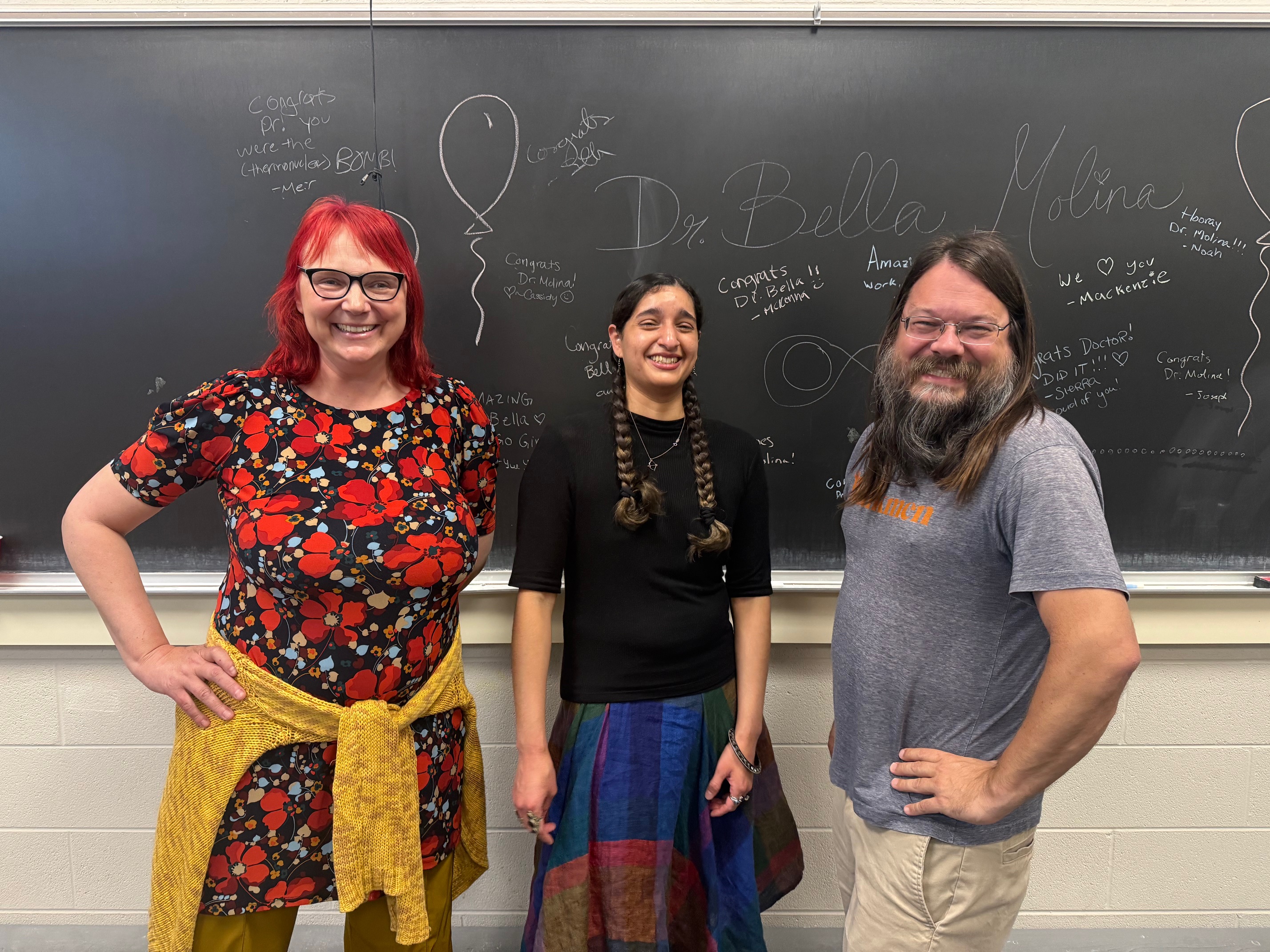
Dr. Bella Molina Successfully Defends her Dissertation
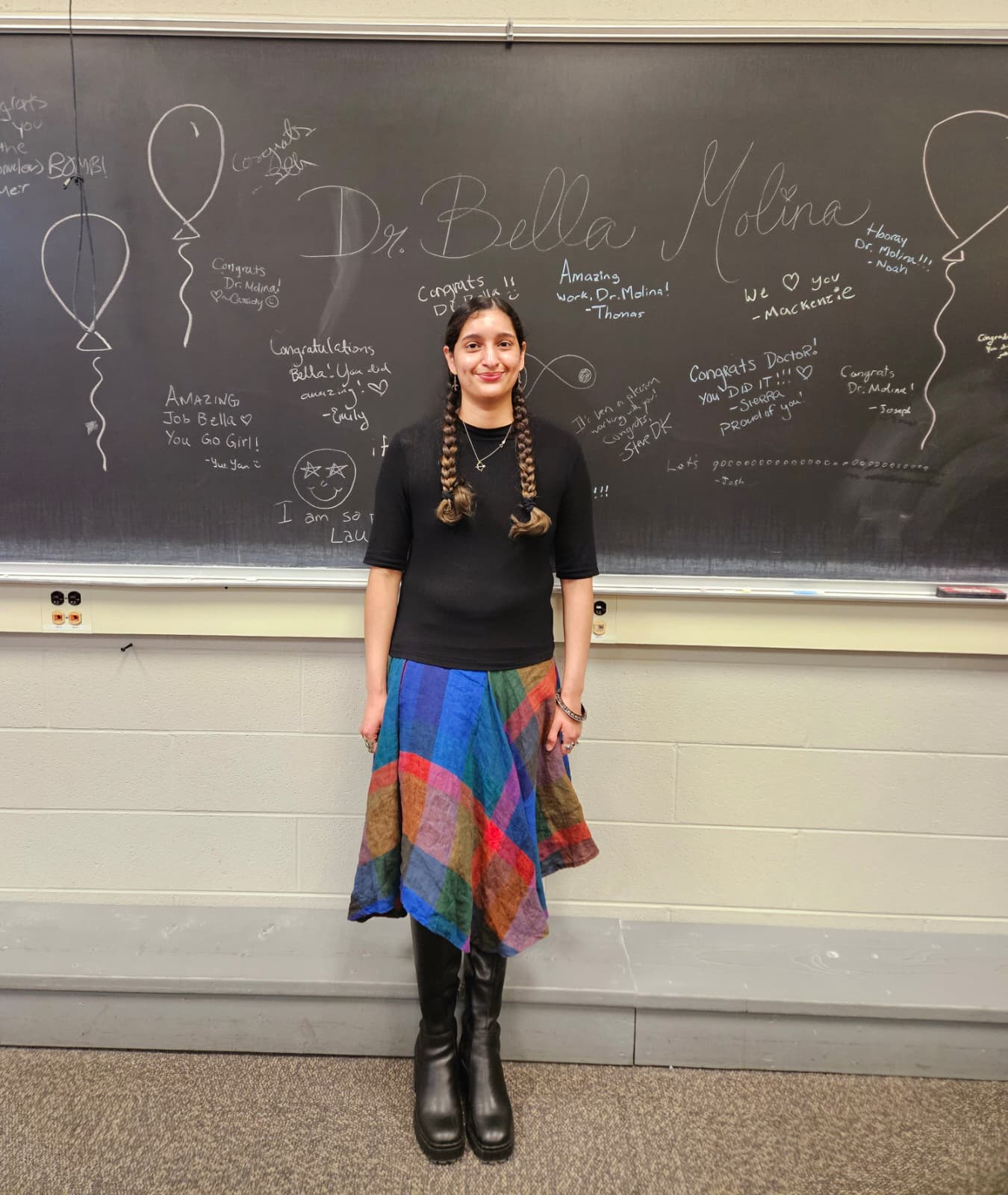
Last week marked the final dissertation defense of the season, given by former PhD candidate Bella Molina, and what a finale it was. She captivated her audience with a thorough discussion of nova processes and her work investigating whether recurrent classical novae with evolved companions could serve as progenitors of Type 1a supernovae. The department, along with her friends and family, would like to congratulate Dr. Bella Molina on successfully defending all the work she has completed over the past six years.
Dr. Molina is supported by her advisor, Dr. Laura Chomiuk, who has not only guided her as research scientist, but also as a teacher and a leader. Dr. Molina has been recognized by the Physics and Astronomy Department with the DEI Leadership Award. She also serves as a program director, alongside Dr. Chomiuk and Dr. Jay Stader, for the Physics and Astronomy Research for Drew Scholars (PAREDS) program. This program began in the summer of 2021 and provides research and career development opportunities to undergraduates who are Drew Scholars in physics and astronomy. In 2023, she was awarded the Packard Grant for Increasing Diversity in STEM Initiative and the Great IDEA (Inclusion, Diversity, Equity, and Accessibility) Fellowship to fund PAREDS.
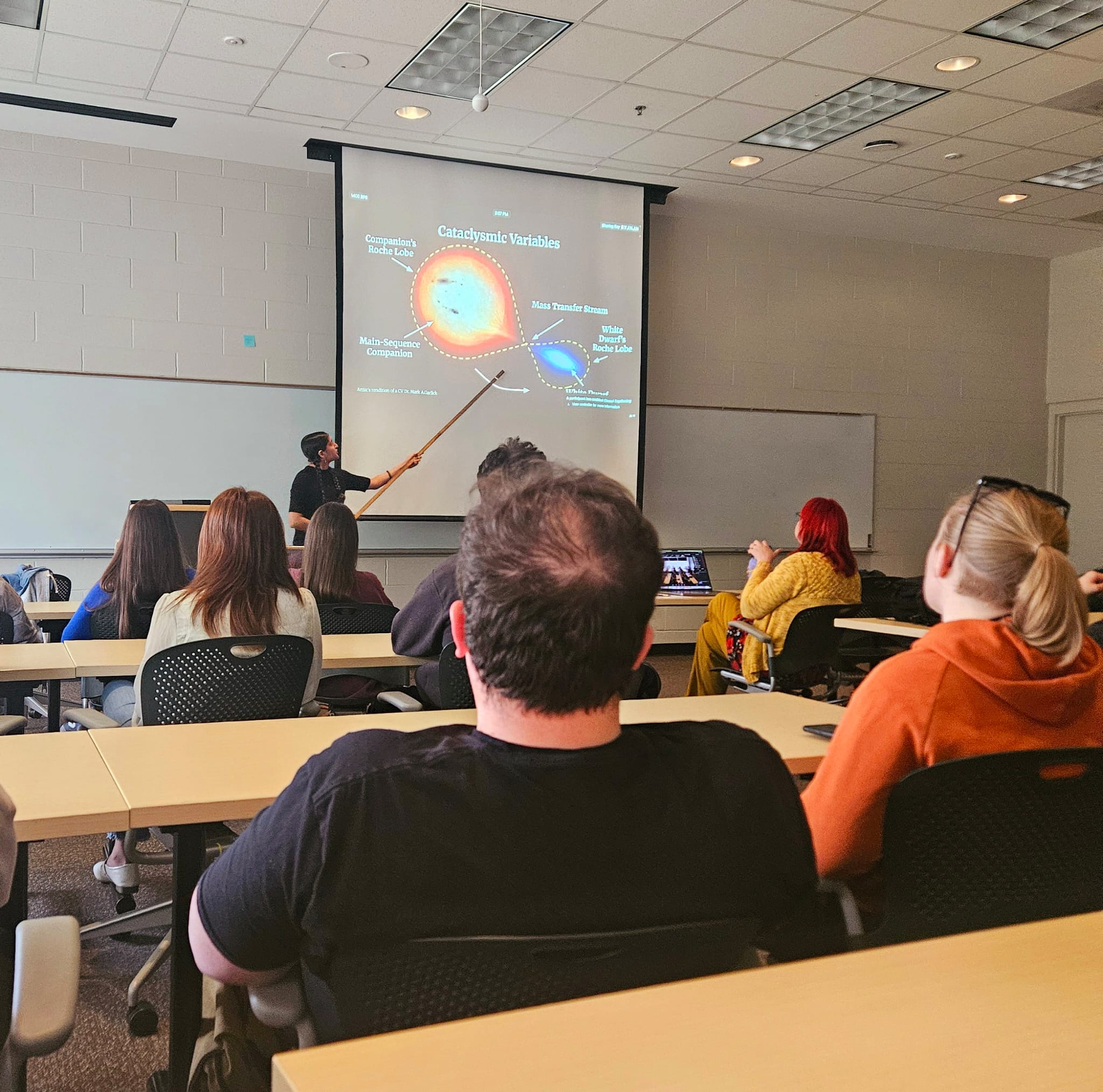 Her passion for teaching extends far beyond mentoring undergraduates. Dr. Molina is
a Future Academic Scholars in Teaching (FAST) Fellow, an award granted to graduate
students in STEM fields with a passion for learning and teaching development in the
STEM fields. As a member of the FAST program, Dr. Molina has been working towards
understanding how to better engage students in physics and astronomy classes. Separately,
she is also working towards a certification for higher education teaching. Her experiences
as both a student and educator in higher education, combined with her dedication to
teaching, have inspired her pursuit of a career as a community college professor.
We wish her the very best as she works toward achieving this goal.
Her passion for teaching extends far beyond mentoring undergraduates. Dr. Molina is
a Future Academic Scholars in Teaching (FAST) Fellow, an award granted to graduate
students in STEM fields with a passion for learning and teaching development in the
STEM fields. As a member of the FAST program, Dr. Molina has been working towards
understanding how to better engage students in physics and astronomy classes. Separately,
she is also working towards a certification for higher education teaching. Her experiences
as both a student and educator in higher education, combined with her dedication to
teaching, have inspired her pursuit of a career as a community college professor.
We wish her the very best as she works toward achieving this goal.
Beyond her accomplishments in leadership and teaching, she was also accepted into the Grote Reber Doctoral Fellowship program, a pre-doctoral program based at the National Radio Astronomy Observatory in Socorro, New Mexico. There, she worked with Dr. Justin Linford to process and image radio data of the recurrent nova V3890 Sgr using the Very Long Baseline Array (VLBA).
The Astronomy Department would like to once again congratulate Dr. Molina on all she has accomplished. We are excited to see how the excellence she demonstrated here will carry forward into her future endeavors.